Echoes of the Battle of Ten Kings: How Vedic Memory May Have Shaped the Mahābhārata
The Mahābhārata's account of King Saṃvaraṇa's fall and recovery resembles the Ṛgvedic story of the Bharatas in the Battle of Ten Kings. This article compares the two traditions and asks whether the epic preserves a reshaped echo of an older political memory.
 By Ashish Choudhary21 November 2026Updated 28 November 20268 min read
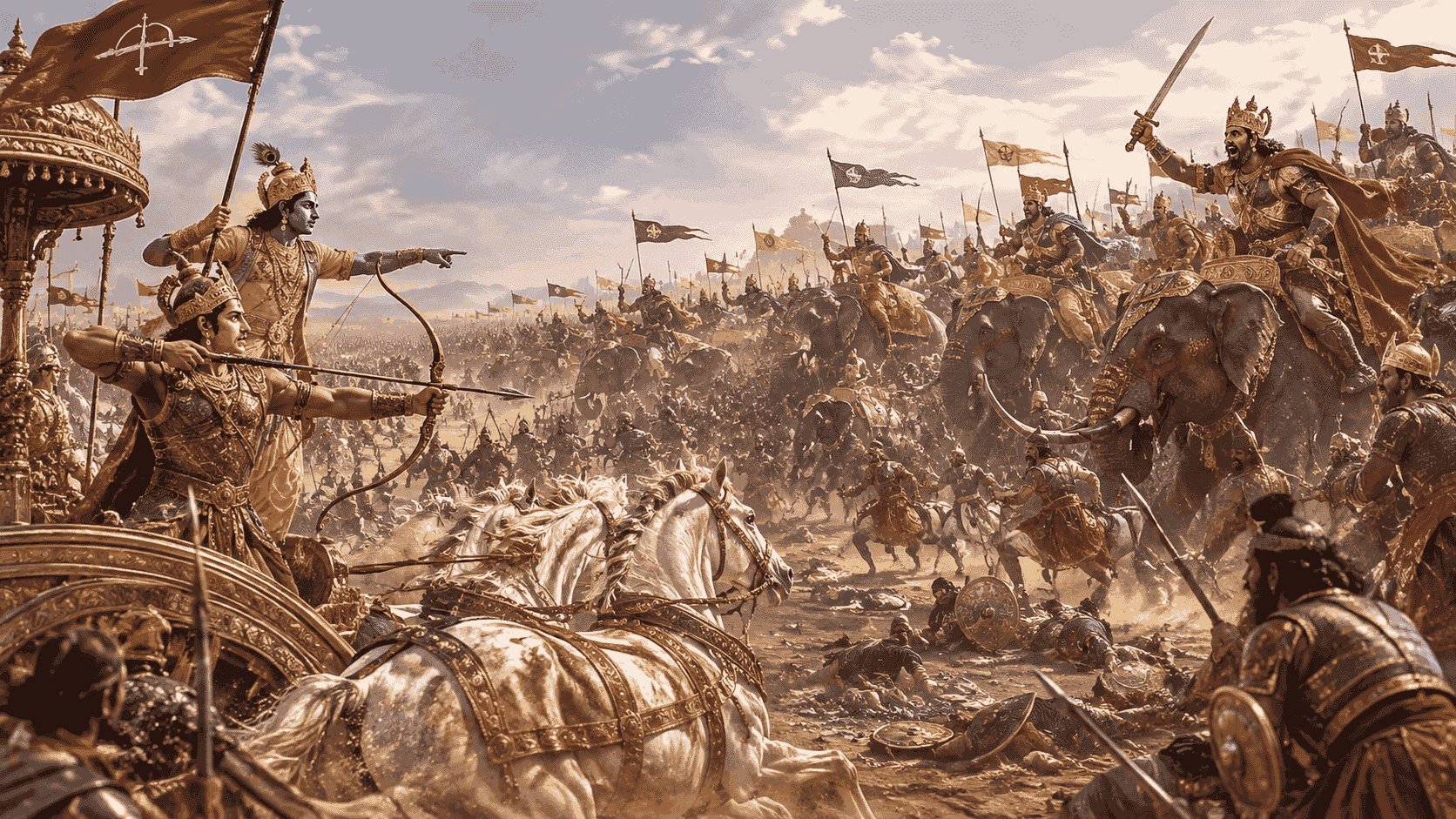
The Dāśarājña War, or the Battle of Ten Kings, stands as one of the most monumental political and military confrontations recorded in the Ṛgveda. Primarily detailed in the seventh maṇḍala, specifically in hymns 7.18, 7.33, and 7.83, the conflict depicts King Sudās defending his realm against a vast coalition of rival groups (ṚV 7.18.7; 7.33.3). Woven into these same Ṛgvedic hymns is an equally compelling sub-narrative: the acute political vulnerability of the Bharatas and the pivotal role played by the sage Vasiṣṭha in their subsequent resurgence (ṚV 7.33.6).
A remarkably similar narrative architecture appears centuries later in the Mahābhārata (Ādiparvan 1.89.31–43). In the epic tradition, King Saṃvaraṇa suffers a catastrophic political collapse, faces a crushing defeat by a Pañcāla ruler, retreats with the Bharata community toward the Sindhu, and is ultimately restored to sovereignty after accepting Vasiṣṭha as his purohita, paving the way for the birth of Kuru (MBh 1.89.31–43). Comparing these two accounts suggests that the Saṃvaraṇa narrative may represent a possible echo or genealogically transformed memory of an older Bharata political crisis associated with the Dāśarājña tradition, rather than a direct, proven historical identity between the two events.
The Diminished Bharatas: Political Weakness and Crisis
Both traditions ground their narratives in an initial epoch of acute political vulnerability for the Bharata community. In the Ṛgveda, hymn 7.33.6 offers a stark depiction of the Bharatas’ weakened condition prior to Vasiṣṭha’s leadership:
daṇḍā ived goajanāsa āsan
paricchinnā bharatā arbhakāsaḥ |
abhavac ca puraetā vasiṣṭha
ād it tṛtsūnāṃ viśo aprathanta ||
(ṚV 7.33.6)
Here, the Bharatas are explicitly described as paricchinnāḥ (cut off, restricted, or diminished) and arbhakāsaḥ (small, weak, or insignificant), compared to cattle-driving sticks (daṇḍā iva goajanāsaḥ).
The Mahābhārata mirrors this exact thematic starting point in its depiction of Saṃvaraṇa’s reign (MBh 1.89.31–32). A great calamity strikes the populace (saṃkṣayaḥ sumahān āsīt prajānām, MBh 1.89.31), and the kingdom disintegrates under the crushing blows of famine, drought, widespread death, and disease (MBh 1.89.32). In both traditions, Bharata political authority is brought to the brink of collapse before any recovery takes place.
Northwestern River Geography: The Paruṣṇī and the Sindhu
Geographical markers anchor both traditions within the northwestern riverine landscape of the subcontinent, though their specific tactical contexts differ. The Ṛgveda situates the central Dāśarājña confrontation along the Paruṣṇī river (ṚV 7.18.8–9), while separately recalling the crossing of the Sindhu and the defeat of Bheda through Indra’s aid and the Vasiṣṭhas’ prayers (ṚV 7.33.3).
Similarly, the Mahābhārata describes Saṃvaraṇa fleeing after his military defeat and settling with the displaced Bharatas in a secluded, inaccessible region near the great Sindhu river, close to a mountain (sindhor nadasya mahato nikuñje nyavasat tadā / nadīviṣayaparyante parvatasya samīpataḥ, MBh 1.89.35). While these shared references to the Sindhu and the northwestern river system do not prove that both texts describe the exact same battle or location, they situate both political crises within an overlapping geographical horizon.
Confrontation with Rival Coalitions and the Later Pañcāla Identity
In both traditions, Bharata political survival is threatened by formidable external adversaries, though the ethnic and political terminology reflects the distinct historical eras in which each text was composed. In the Mahābhārata, Saṃvaraṇa is defeated in battle by a powerful Pañcāla ruler (pāñcālya) commanding an immense force of ten akṣauhiṇīs, forcing the king and his community into exile (MBh 1.89.33–34).
In the Ṛgveda, Sudās faces a broad coalition of rival peoples, including the Pakthas, Bhalānas, Alinas, Śivas, and Viṣāṇins (ṚV 7.18.7), alongside the broader grouping of the pañcajana (“five peoples,” such as the Yadus, Turvaśas, Druhyus, Anus, and Pūrus). It is important to note that Pañcāla is a later post-Ṛgvedic political designation that does not appear in the Ṛgveda itself. Rather, later Vedic texts indicate that the Pañcāla confederacy coalesced out of earlier Ṛgvedic tribes, most notably the Krivis and elements of the Turvaśas, who appear among Sudās’s opponents in ṚV 7.18.6. Thus, rather than representing a direct one-to-one equivalence between pañcajana and Pañcāla, the epic account likely reframes an older memory of conflict with rival northwestern and Madhyadeśa coalitions using the geopolitical nomenclature of its own era.
Vasiṣṭha’s Intervention as the Turning Point
The most striking structural parallel between the two traditions lies in the intervention of Vasiṣṭha at the nadir of Bharata fortunes. In ṚV 7.33.6, immediately after describing the Bharatas as diminished and weak, the hymn declares that Vasiṣṭha became their puraetā, the leader who goes before them (abhavac ca puraetā vasiṣṭha), whereupon the Tṛtsu communities expanded (ād it tṛtsūnāṃ viśo aprathanta). Earlier in the same hymn, Indra is praised for hearing Vasiṣṭha’s invocation and creating wide space (urum… ulokam) for the distressed Tṛtsus (ṚV 7.33.5).
In Mahābhārata 1.89.36–40, after the Bharatas endure prolonged exile near the Sindhu, the sage Vasiṣṭha arrives at their refuge (MBh 1.89.36). King Saṃvaraṇa entreats him to become their purohita so they may strive to regain their kingdom (purohito bhavān no ’stu rājyāya prayatāmahe, MBh 1.89.38). Vasiṣṭha accepts (MBh 1.89.38), consecrates the Paurava ruler to imperial sovereignty (sāmrājya, MBh 1.89.39), and enables him to reoccupy his former capital and exact tribute from surrounding rulers (MBh 1.89.40). In both accounts, Vasiṣṭha’s leadership functions as the decisive turning point transforming crisis into political recovery.
From the Bharatas to the Rise of Kuru
A final structural parallel links this political restoration to a shift in dynastic identity. In the Ṛgveda, the Bharatas and Tṛtsus occupy center stage during the Dāśarājña hymns (ṚV 7.18; 7.33; 7.83), whereas in later Vedic literature (such as the Brāhmaṇas and Atharvaveda), the standalone political prominence of the Bharatas recedes as they merge into the newly dominant Kuru polity.
The Mahābhārata captures a comparable transition in genealogical form. Immediately following Saṃvaraṇa’s restoration to the throne (MBh 1.89.39–40), the narrative proceeds to his union with Tapatī and the birth of Kuru (MBh 1.89.42–43), from whom the famous Kuru lineage derives its name. Within Indian epic tradition, clans and dynasties are regularly named after illustrious kings born at pivotal moments of renewal. In this way, Saṃvaraṇa’s recovery bridges directly into the emergence of the Kuru name, echoing the broader socio-political shift visible across Vedic literature.
Summary Comparison of Textual Parallels
Political Weakness
- Ṛgveda (Maṇḍala 7): Bharatas are paricchinnāḥ and arbhakāsaḥ (ṚV 7.33.6)
- Mahābhārata (Ādiparvan 1.89): Kingdom devastated by famine, drought, and disease (MBh 1.89.31–32)
- Analytical qualification: Shared motif of acute initial vulnerability
River Geography
- Ṛgveda (Maṇḍala 7): Battle at the Paruṣṇī (ṚV 7.18.8–9); crossing of the Sindhu (ṚV 7.33.3)
- Mahābhārata (Ādiparvan 1.89): Exile in a secluded region near the Sindhu (MBh 1.89.35)
- Analytical qualification: Shared northwestern geographical horizon, not identical battle sites
Adversaries
- Ṛgveda (Maṇḍala 7): Coalition including Turvaśas and pañcajana (ṚV 7.18.6–7)
- Mahābhārata (Ādiparvan 1.89): Defeat by a Pāñcāla ruler (MBh 1.89.33)
- Analytical qualification: Pañcāla is a later ethnonym incorporating older Ṛgvedic tribes like the Turvaśas
Priestly Pivot
- Ṛgveda (Maṇḍala 7): Vasiṣṭha becomes puraetā, leading to Tṛtsu expansion (ṚV 7.33.6)
- Mahābhārata (Ādiparvan 1.89): Vasiṣṭha becomes purohita and consecrates Saṃvaraṇa (MBh 1.89.38–39)
- Analytical qualification: Core structural parallel in both traditions
Dynastic Shift
- Ṛgveda (Maṇḍala 7): Bharatas later merge into the Kuru polity in post-Ṛgvedic texts
- Mahābhārata (Ādiparvan 1.89): Restoration is followed by the birth of Kuru (MBh 1.89.42–43)
- Analytical qualification: Genealogical reflection of a historical shift in clan identity
Conclusion
The parallels between the Dāśarājña War tradition and the epic account of King Saṃvaraṇa suggest that the Mahābhārata may preserve a resonant, genealogically reshaped echo of an older Bharata political crisis. While Sudās and Saṃvaraṇa cannot be equated as the same historical figure, and the later Pañcāla conflict cannot be collapsed directly into the Ṛgvedic pañcajana, the shared narrative sequence of political diminishment, northwestern river displacement, Vasiṣṭha’s priestly intervention, restoration of authority, and the subsequent rise of the Kuru name points to an enduring cultural memory. Examining these two traditions side by side illustrates how epic historiography transformed early Vedic political experiences into foundational dynastic narrative.
Bibliography
Aufrecht, Theodor, ed. 1877. Die Hymnen des Rigveda. 2 vols. Bonn: Adolph Marcus.
Jamison, Stephanie W., and Joel P. Brereton, trans. 2014. The Rigveda: The Earliest Religious Poetry of India. 3 vols. New York: Oxford University Press.
Macdonell, Arthur Anthony, and Arthur Berriedale Keith. 1912. Vedic Index of Names and Subjects. 2 vols. London: John Murray.
Sukthankar, V. S., ed. 1933. The Mahābhārata: For the First Time Critically Edited. Vol. 1: Ādiparvan. Poona: Bhandarkar Oriental Research Institute.
Wilson, H. H., trans. 1866. Rig-Veda-Sanhitá. Vol. IV. Edited by E. B. Cowell. London: Trübner.
Witzel, Michael. 1995. “Ṛgvedic History: Poets, Chieftains and Polities.” In The Indo-Aryans of Ancient South Asia, edited by George Erdosy, 307–352. Berlin: de Gruyter.