The Jet That Fell Apart: The Comet Disaster Of 1954
The world’s first jet airliner broke apart in mid-air three times in two years. How a water tank at Farnborough revealed metal fatigue and changed aircraft design for good.
 By Sebin Michael
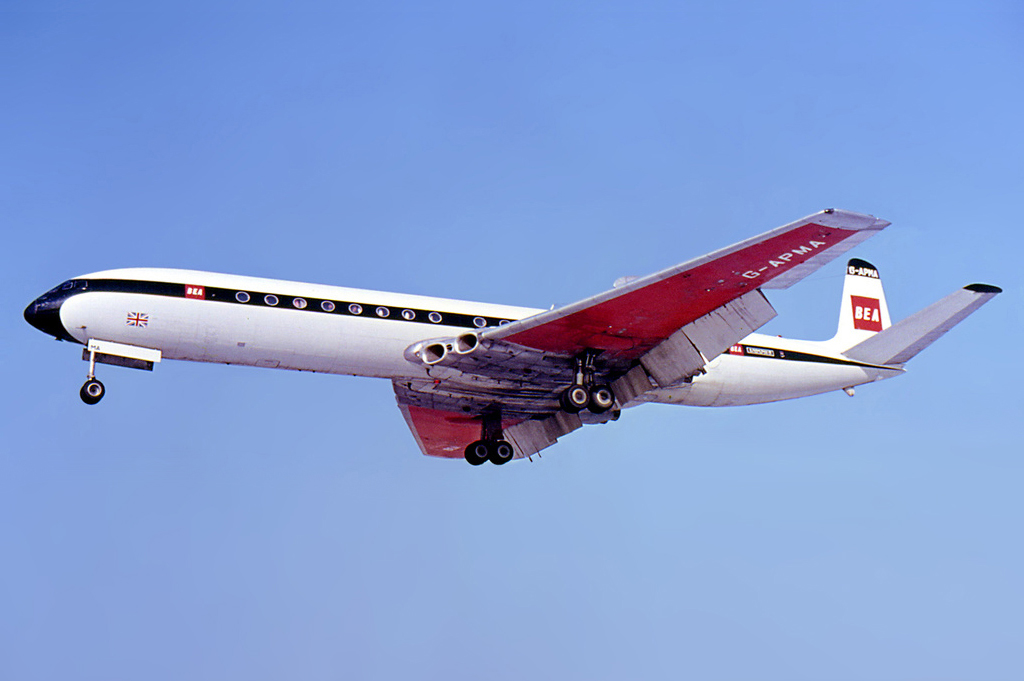
The Future Arrives Early
On 2 May 1952, a de Havilland Comet lifted off from London bound for Johannesburg. It was a quiet moment in a noisy century, but it changed travel for good. The Comet was the first jet airliner in the world to enter regular passenger service, and it made every other aircraft in the sky look like a relic.
It flew at around 35,000 feet, above the weather that tossed propeller aircraft around. It cruised at roughly twice their speed. It was so smooth that, according to the stories told at the time, passengers could stand a coin on its edge on the table. Britain, battered by war and short of money, had done something extraordinary. It had won the race to the jet age. Within two years, three Comets had broken apart in the sky. This is the story of how the most advanced aircraft in the world became the most feared, and of the strange, patient detective work that explained why.
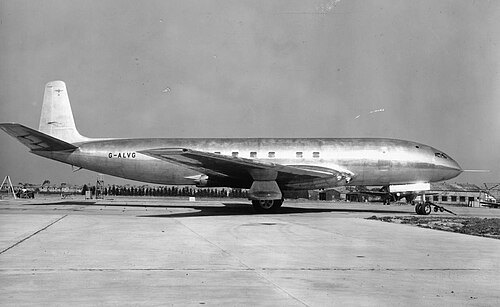
Comet 1 prototype (with square windows) at Hatfield Aerodrome in 1949 (By Government of the United Kingdom - This photograph ATP 18376C comes from the collections of the Imperial War Museums. Public Domain, https://commons.wikimedia.org/wiki/Special:Redirect/page/18083161)
A British Dream
The idea of a jet airliner was born in the last years of the Second World War. Britain had pioneered the jet engine, and a government body known as the Brabazon Committee looked ahead to peacetime and asked what the country could build to dominate civil aviation. One answer was a fast, pressurised, jet-powered mail and passenger aircraft.
De Havilland, a company with a famous record in fast aircraft, took on the challenge. The Comet made its first flight on 27 July 1949. It had four Ghost turbojet engines buried in the wing roots, a sleek polished fuselage and a pressurised cabin that let passengers sit comfortably at altitudes where the air outside is far too thin to breathe.
That pressurised cabin is the heart of this story. To keep passengers comfortable, the fuselage had to hold air at a much higher pressure than the thin atmosphere outside. On every flight, the aircraft was inflated like a balloon on the way up and relaxed on the way down. Fly, land, repeat. Thousands of times. Nobody had flown such a cabin at that altitude, at that scale, in regular passenger service. The Comet was, in the plainest sense, an experiment carrying paying customers.
The Warning Signs
The early service was glamorous, and it was not trouble free. In October 1952, a Comet failed to get airborne at Rome and ran off the end of the runway. In March 1953, another Comet crashed on takeoff at Karachi, killing everyone on board. These accidents were traced to how the aircraft was handled during takeoff, including the shape of its wing leading edge, and changes were made. They did not point to anything wrong with the fuselage itself. Then came 2 May 1953, exactly a year after the service had begun. BOAC Flight 783 left Calcutta’s Dum Dum airport and crashed minutes later near Jagalgori, in the path of a violent pre-monsoon thunderstorm. All 43 people aboard died.
The investigators concluded that the aircraft had broken up in the air after being overstressed by severe turbulence. The storm took the blame. It was a convenient and believable answer, since the weather over Bengal in that season is notorious. Some of the aircraft’s tail and wing structure had been found over a wide area, which suggested it had come apart in flight, but nobody linked it to a deeper flaw. Looking back, historians have asked whether fatigue was already at work. We will never be sure. What we do know is that a warning had been given, and the world took it for something else.
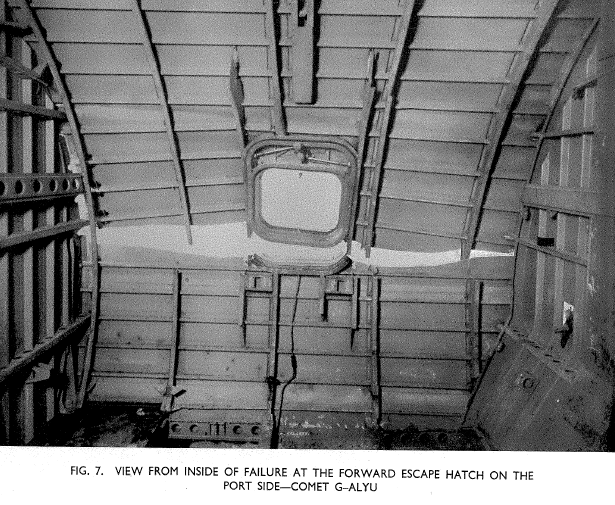
Image from the Cohen Inquiry Report showing fuselage failure under water pressure test of Comet 1 G-ALYU. Note intact escape hatch window frame (By HM Stationery Office - Cohen Inquiry report into the Accidents of Comet G-ALYP and G-ALYY Fig 7, CC BY-SA 4.0, https://commons.wikimedia.org/wiki/Special:Redirect/page/126153237)
Elba: 10 January 1954
Nine months later, the Comet’s second silent warning came in clear sky. BOAC Flight 781 left Rome’s Ciampino airport for London on the morning of 10 January 1954. The aircraft was G-ALYP, known by its radio letters as Yoke Peter. It climbed toward its cruising altitude. At about 27,000 feet it broke apart. The wreckage fell into the Mediterranean not far from the island of Elba. All 35 people aboard were killed.
Among the passengers was Chester Wilmot, a well-known Australian war correspondent and broadcaster, and many other ordinary travellers. It was a loss that the British public felt personally. The Comet was a source of national pride, and now it was falling out of the sky on a calm day. Investigators found no clear answer. Fishermen and witnesses reported seeing wreckage fall. The sea was deep, and most of the aircraft lay on the seabed. Without the wreckage, theories multiplied. Was it an engine failure? A fire? A control surface fluttering itself to pieces? A bomb? The Comet fleet was grounded, checked, and modified in many places. Engineers reinforced engine fire protection and fixed many small flaws that had been identified during the search. On 23 March 1954, the Comets returned to service. The public was told that the problems had been understood and solved. They had not.
Naples: 8 April 1954
Fifteen days later, on 8 April, a Comet operated by South African Airways on charter from BOAC took off from Rome for Cairo. This was Flight 201, G-ALYY. It disappeared from radio contact and fell into the sea south of Naples. All 21 people on board were killed. This time there could be no more half answers. Two Comets had broken up at high altitude, within three months, after leaving the same airport. The certificate of airworthiness was withdrawn. The most advanced airliner in the world was now a grounded aircraft with no known fault. The British government, under Prime Minister Winston Churchill, made it a national priority to find the cause. The stakes were not only human. The whole British lead in jet aviation was at risk. If the cause could not be found, no one could trust the aircraft. And if the cause could not be fixed, the lead would be lost.
The Longest Search
What followed was one of the great investigations in the history of engineering. The Royal Navy launched a major salvage operation off Elba. Working in deep water, ships and trawlers dragged and searched the seabed for fragments of G-ALYP. The operation used underwater television cameras for the first time in an accident investigation. Over weeks and months, a large part of the aircraft was recovered and brought to the Royal Aircraft Establishment at Farnborough, where it was laid out and pieced together like a three-dimensional jigsaw. At Farnborough, a team led by Sir Arnold Hall tried to find what had failed first. The pieces told a story. The wreckage showed that the pressurised cabin had burst open and torn apart. The failure had begun in the roof of the cabin, near the openings for the aircraft’s automatic direction finding aerials. These openings were covered by panels in a way that looked like windows. A fatigue crack, a slow-growing fracture in the metal, had started near a rivet hole at the corner of one of these cutouts. But a single piece of wreckage proves little. Investigators needed to know if the rest of the Comet fleet had the same weakness. So they carried out a test that no one had ever attempted on this scale.
The Water Tank
They took a complete Comet fuselage, G-ALYU, which had already flown over 1,200 pressurised flights, and placed it in a huge tank of water at Farnborough. The tank had a clever purpose. Water cannot be compressed the way air can, so if the fuselage burst, the destructive energy would be harmless. Engineers could pressurise it with water again and again, simulating the stresses of each flight, without risk of an explosion.
The team ran the cycles, up and down, up and down, day after day, imitating the climbing and descending of real service. After roughly 1,800 more simulated flights, the fuselage failed. In total, the aircraft had experienced about 3,060 pressurised cycles, a mix of real flights and tank tests. The crack began at the corner of a forward escape hatch cutout, an opening with the same kind of sharp geometry as the windows, and it opened up the fuselage. The result matched the wreckage from the sea. The Elba aircraft had made about 1,290 pressurised flights. The Naples aircraft had made about 900. These numbers were far lower than the 16,000 cycles that de Havilland’s own tests had suggested the structure could survive. The message was clear. The Comet was not unlucky. It was doomed by its own design. The aircraft’s skin was fatiguing, cycle by cycle, far sooner than anyone had calculated.
The Enemy Called Fatigue
Metal fatigue is a simple idea with a cruel logic. Bend a paperclip once and it holds. Bend it back and forth and it snaps. The metal does not need to be overloaded. It only needs to be loaded again and again. Tiny cracks appear at points where stress is concentrated, such as sharp corners and holes, and then creep outward with each cycle until what remains cannot bear the load. Engineers knew about fatigue. Railway axles and bridges had taught that lesson. What they had not done was understand how it applied to a thin pressurised aircraft skin, flown at high altitude, thousands of times, with openings cut through it.
The Comet’s windows and cutouts had tight corners. Stresses piled up at those corners to levels far higher than the designers had predicted. Rivet holes made by punching, rather than drilling, left tiny flaws that gave cracks a place to start. And the structural testing that had given such confidence had its own problems. Some historians have argued that the earlier proof tests on the test fuselage may even have made it seem stronger than it really was. The calculations looked sound on paper. The reality of the sky was harsher. It would be easy to say that the Comet’s square windows killed 56 people. It is closer to the truth to say that a whole way of thinking was not ready for the jet age.
The Inquiry
In October 1954, a public inquiry opened in London, led by Lord Cohen. It was a remarkable moment of public accountability. Evidence from the Royal Aircraft Establishment, de Havilland, BOAC and the government was heard in the open, and the nation followed it closely. The inquiry’s report, published in early 1955, was blunt. The Elba accident was caused by structural failure of the pressure cabin, brought about by fatigue. There was no villain in the story, no sabotage, no pilot error. There was a system that had made a very human mistake. It had built something new, tested it with the best methods it had, and trusted the result. It is one of the most important lessons the history of technology can teach. The danger is not always in what we do carelessly. It is often in what we do carefully, but with incomplete knowledge.
The Comet Comes Back
De Havilland did not give up. The company redesigned the aircraft, with a thicker skin, a stronger structure and oval windows, which spread stress more evenly than sharp corners. The new Comet 4 first flew on 27 April 1958, and in October that year it operated the first transatlantic jet airliner service, narrowly ahead of the Boeing 707.
But the delay had cost too much. The Boeing 707 had been developed in the years the Comet spent grounded, and it benefited from the hard lessons of the Comet disasters. It entered service the same month and soon swept the market. The Comet 4 flew safely for many years, and a version of it served the Royal Air Force as the Nimrod patrol aircraft for decades. But Britain’s early lead in civil jet aviation was gone. De Havilland itself was absorbed into Hawker Siddeley in 1960. The Comet was beautiful. It was first. And it was first to pay.
What the Comet Left Behind
The Comet disasters did more for aviation safety than almost any other event in the twentieth century.
First, they changed how aircraft are designed. Engineers began to build structures on a fail-safe principle: if one part cracks, the rest of the structure must be able to carry the load until the crack is found. Features such as crack stoppers and carefully designed reinforcement around openings became standard. Fatigue testing of whole airframes became a core part of certification. Every large airliner flying today, in a way, descends from the lessons of those two aircraft that fell into the Mediterranean.
Second, they changed how accidents are investigated. The Comet inquiry showed what a public, scientific and thorough investigation could achieve. It created a model that many countries later followed, in which the aim is not to punish but to learn.
Third, and this is the thread that gives this series its name, the Comet crashes pushed forward the idea of the flight recorder. The Australian scientist David Warren, who worked at the Aeronautical Research Laboratories in Melbourne, was involved in discussions of the Comet accident. He saw how much easier the investigation would have been if the aircraft had carried a recording of its own final moments. He went on to develop an early flight memory unit in the 1950s, a forerunner of the black box. The lessons were never fully complete. In 1988, Aloha Airlines Flight 243, an older Boeing 737, lost part of its cabin roof in flight because of fatigue and corrosion, and one flight attendant died. It was a reminder that metal remembers every flight, and that vigilance never ends.
A Note on Memory
Look out of the window on your next flight. The shape of that window, a gentle oval with rounded corners, is not a matter of style. It is a memorial. It exists because 35 people died near Elba, 21 near Naples, and 43 near Calcutta before them, and because a group of engineers at Farnborough put an aircraft in a tank of water and refused to look away from what it told them. History often remembers disasters as endings. The Comet reminds us that they can also be beginnings.
Sources:
- FAA Lessons Learned from Transport Airplane Accidents, de Havilland DH-106 Comet 1 (G-ALYV entry)
- Report of the Public Inquiry into the causes and circumstances of the accident to the Comet aircraft G-ALYP, 1954
- Andrew Nahum, The Comet (2001)
- Aviation Safety Network wikibase record for G-ALYP
Featured Image Courtesy: By BEA_De_Havilland_DH-106_Comet_4B_Manteufel.jpg: Ralf Manteufelderivative work: Altair78 (talk) - BEA_De_Havilland_DH-106_Comet_4B_Manteufel.jpg, GFDL 1.2, https://commons.wikimedia.org/wiki/Special:Redirect/page/17868134